Monopoly GO: Chance, Tax & Utility Events Explained
Don't lose track of our Monopoly Go! updates on Google
Add SuperCheats as a preferred source to keep our daily events, free dice links, and Monopoly GO guides easy to find in Google search results.

Thank you for printing this page from www.SuperCheats.com.Remember to come back to check for updates to this guide and much more content for Monopoly GO!
Last Updated:
Chance, Tax & Utility is one of several scoring setups that Monopoly Go rotates through for its solo banner events — the big milestone events that sit at the top of your game board and typically run for two or three days at a time. Each scoring type has its own set of tiles that count for points, and this one uses three of them: chance, tax and utility. Once you know how to play one Chance, Tax & Utility event, you know how to play all of them, because the underlying rules don't change from event to event — only the theme, the milestones and the rewards.
This guide covers how the scoring actually works, which section of the board is worth targeting, and when it's worth burning a high multiplier versus keeping things steady. If you've landed here from one of our individual event pages, everything here applies to that event — we keep the event pages lean so we can give you the milestones, rewards, and our specific take on how far to push, and we leave the full strategy breakdown in one place.
How scoring works
Points come from landing on one of three tile types: chance, tax or utility. The breakdown is simple:
- Chance tiles — 2 points
- Tax tiles — 3 points
- Utility tiles — 2 points
Whatever base points you score, they're then multiplied by whichever dice multiplier you used for that throw. So a tax tile landed with a x10 multiplier is 30 points, and the same tile landed with a x4 is 12 points. That's the whole scoring system.
The important thing to understand is that these tiles are not evenly distributed around the board. If they were, the strategy would just be "roll as big as possible and hope for the best" — but they're not, and that changes everything.
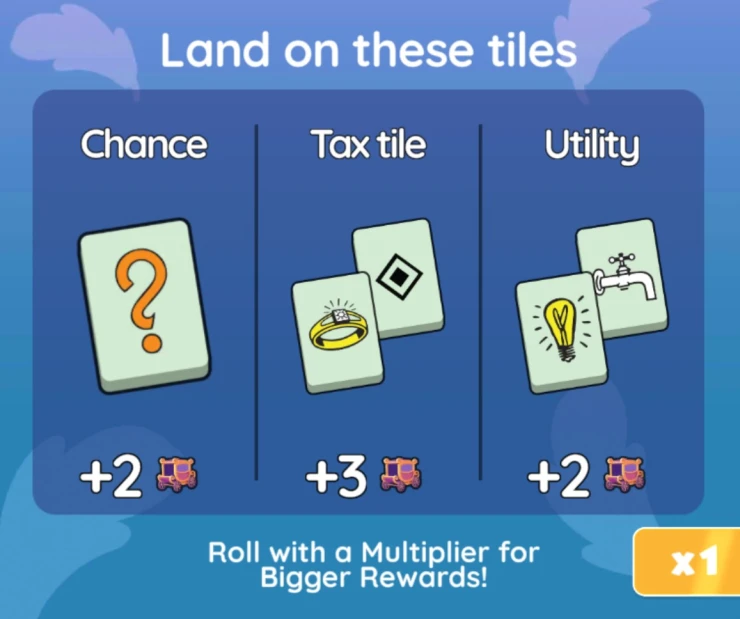
Chance, Tax and Utility tile points
Where to aim — the Go corner is where the points live
There are two tax tiles on the board, and they both sit close to the Go square at the end of the final side of the board. Two chance tiles are also in that same area. That's four scoring tiles bunched into roughly twelve squares, and no other section of the board comes close to that density, especially when you consider as well the railroad tiles which will give you tournament points too.
What that means practically: for most of the board you're not really trying to score, you're just trying to get to the Go corner in decent shape so you can use a bigger multiplier when you actually have a decent shot at landing on something to give you some points. That's the single most important concept for these events.
The rest of the board has two utility tiles, water works and electricity company, which are quite spread apart. Both sitting on their own with nothing nearby to bail you out if you miss. Not worth a big roll in my opinion.
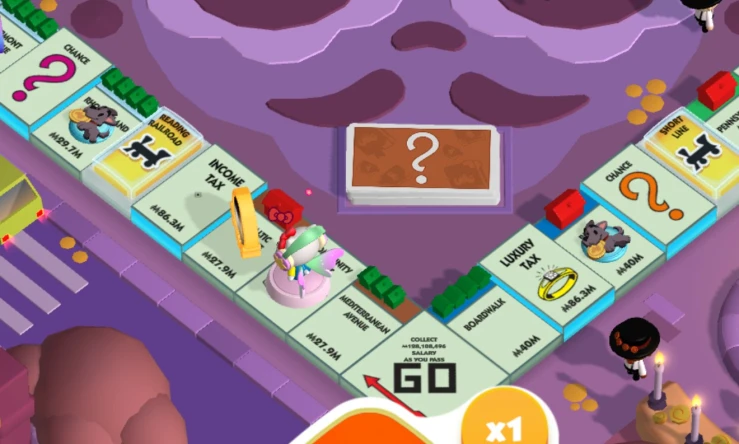
The GO corner is where the most point scoring tiles are for this event
When to go big and when to hold back
My general rule is low multiplier for most of the board, and save the big rolls for the approach to the Go corner. Specifically, once I'm past Go to Jail I start thinking about whether the next roll can reach one of the scoring tiles in the final stretch.
A few things worth knowing:
- Auto roll is the enemy. You'll burn through your dice on x10 or whatever your auto multiplier is set to, and most of those rolls will be on dead squares. Turn it off for these events — manually picking your moments is worth the extra effort.
- Tax tiles give you a safety net. Even if you miss the exact tax tile you were aiming for, the section around Go has chance tiles and railroads close by, so a slightly off roll often still gets you something. That's not true for utility tiles on their own.
- Chance tiles do double duty. As well as the 2 points they score for the event, landing on a chance tile can send you forward to the next railroad or give you extra dice. Either of those is a good outcome — the railroad gives you tournament points, and the free dice effectively refund part of the roll you just used.
- Shield tiles don't score, but they're not a waste. If you've lost some of your shields to Bank Heists, landing on a shield tile restores them, any any left over will be returned as dice. For example, if you rollled on x20, and had one missing shield, well that one shield will get added back, and you'll get 19 dice returned to you.
Stacking this with whatever else is running
There is always a tournament running alongside a Chance, Tax & Utility event, and that tournament scores on railroads. Railroads sit at four points on the board, one at the midway point of each side, ten squares apart. So when you're lining up a roll for a tax tile near the Go corner, you've also got a railroad in that same stretch — overshoot the tax tile and land on the railroad instead, and you've still scored tournament points and triggered Shutdown or Bank Heist. That's why I always say the final section of the board is the money spot. There are no-scoring outcomes in that stretch.
If there's a partner event or a racer event running at the same time, you may also see partner tokens or flags appearing as extra items on the board, which gives you yet another reason to be rolling carefully through the high-value section.
Dig events work differently. There are no pickaxes physically on the board to land on — instead, the pickaxes (or laser guns, wands, whatever the current dig event uses) sit inside the milestone rewards of both the banner event and the tournament. So every point you score in the Chance, Tax & Utility event is dragging you towards a dig event reward, even though the dig event itself isn't represented on the board you're rolling on. Partner event tokens and flags are also in the milestone rewards when the relevant events are also running.
Boost events that matter for these events
A few of the flash boosts that can appear during a Chance, Tax & Utility event are worth timing your play around:
- Cash Boost — straightforward, more game cash per roll. Good if you're saving up for landmark upgrades.
- Builder's Bash — discounts on landmark upgrades, which pairs really well with Color Wheel Boost if you can line them up. Load up on hotels during Bash, then spin the wheel during the Color Wheel window.
- High Roller — lets you roll at higher multipliers than the usual cap. Basically a license to go aggressive on the Go corner.
- Mega Heist — extra cash and extra tournament points from Bank Heists. If the tournament running alongside your banner event is a priority, time your railroad landings for this.
Check our daily events schedule for predicted boost times today, and our Boost Events Explained page if you want the full breakdown of what each one does.
FAQs for Chance, Tax & Utility Events
Do auto roll and this event type mix?
Not really. You'll score some points by accident but you'll burn far more dice than you need to. Manual rolling is worth the extra attention for any event you actually care about clearing.
Should I bother with utility tiles?
Only if you're passing close to one on a low-multiplier roll anyway. Don't go hunting for them with a big multiplier — they're isolated and the risk isn't worth the 2 points.
How many points is a perfect roll worth?
The highest-value single landing is a tax tile hit with your maximum multiplier. At x10 that's 30 points, at x100 during High Roller that's 300. Plan your Go corner approach around whatever multiplier cap you have available.
Why does the Go corner get all the good stuff?
Luck of the board layout. Scopely didn't design it specifically for event scoring, but the natural clustering of tax and chance tiles in that section has made it the obvious target for this event type.
Wrapping up
Every Chance, Tax & Utility event on Monopoly Go plays roughly the same way, so once you've got the Go corner strategy down it'll serve you for every future event in this scoring type. Head back to the specific event page you came from for the milestones, rewards list, and my take on how far to push in that particular event, or check our daily events schedule to see what's currently live.
Next Page
Monopoly GO: Corners Events Explained
Previous PageMonopoly GO: Boost Events Explained
Guide Menu
We have questions and answers related to this topic which may also help you:
Anything missing from this guide?
ASK A QUESTION for Monopoly GO!Comments for Monopoly GO: Chance, Tax & Utility Events Explained
SuperCheats is an unoffical game information site and not associated with Scopely.
Table of ContentsClose
- Introduction
- Free Monopoly Go Dice Links - Updated Daily
- Ultimate Guide to Sticker Packs in Monopoly GO!
- How many Boards are there in Monopoly Go?
- Golden Blitz Schedule - When is the Next Golden Blitz Event?
- Peg-E Prize Drop Schedule - When is the Next Prize Drop event on Monopoly Go?
- How to Get More Free Prize Drop Chips
- When is the Next Co-Op Partners Event on Monopoly Go?
- When is the Next Sticker Boom Event Scheduled on Monopoly Go
- When is the Next Builder's Bash Scheduled on Monopoly Go
- When is the Next High Roller Event on Monopoly Go?
- How to Send Stars in Monopoly Go
- All Monopoly Origins Stickers Listed on Monopoly Go
- How Much Does it Cost to Upgrade Each Level or Board in Monopoly Go
- Monopoly Go Wild Stickers Explained - Everything You Need to Know
- Monopoly Games Season Guide and Sticker List
- Log in Limit explained
- When is the next treasure dig event on Monopoly Go?
- What is Bank of Monopoly in Monopoly Go
- Monopoly Go Swap Pack Explained
- Monopoly Go reward codes - do they exist?
- Monopoly Go Tycoon Club Explained
- Monopoly Go: How to access Tycoon Club on Android
- How to Join Tycoon Club on Monopoly Go
- How to get more Swap Packs in Monopoly Go
- Best Lucky Rocket Strategy in Monopoly Go
- Ball and Chain in Tycoon Racers Strategy Explained
- How to play Jawa Chase in Monopoly Go
- Monopoly Go Tycoon Express Guide
- Monopoly Go Adventure Club
- How to win the Red Six Star Pack from Community Chest in Monopoly Go
- How to prepare for the next season on Monopoly Go
- Monopoly Go's Tycoon Racer Isn't a Dice Trap - Here's Why
- How to get Style Tokens for Posh Pets in Monopoly Go
- Monopoly GO: Posh Pets Album & Sticker List (All Sets)
- Monopoly GO Hello Kitty and Friends crossover starts March 10 2026
- Monopoly Go When is the next sticker album release date
- Monopoly GO: Monopoly Ever After Album & Sticker List (All Sets)
- Monopoly GO: Boost Events Explained
- Monopoly GO: Chance, Tax & Utility Events Explained
- Monopoly GO: Corners Events Explained
- Monopoly GO: Chance, Community Chest & Railroad Events Explained
- Monopoly GO: Tax and Utility Events Explained
- Monopoly GO: Pickups Events Explained
- Monopoly GO The Simpsons Album Guide, Sticker List and Rewards
- Monopoly GO Happy Harvest Album Guide, Sticker List and Reward
- Monopoly GO Monster Mash Album Guide, Sticker List and Reward
- Events
- Event Archives
 Join us on Discord
Click to close


To chat with other Monopoly Go players, visit our forum to trade, discuss the game or talk tactics.