The Story -- An Overview
Thank you for printing this page from www.SuperCheats.com.
Remember to come back to check for updates to this guide and much more content for The Simpsons: Tapped Out
Follow this guide to hear about updates
By CMBF

Last Updated:
That venerable idiot Homer Simpson is ultimately at fault for a disaster that destroys the town of Springfield, Oregon and the surrounding retirement community of Springfield Falls, the survivalist village of Springfield Green, and an old logging town now converted into a theme park called Krustyland.
Employed as the Senior Safety Officer at Springfield's Nuke Plant, Simpson occupies one of the critical monitoring and safety stations commonly knows as a "Reactor Safety SCRAM Station."
The name of the safety station is actually an acronym that stands for Safety Control Rod Axe Man -- a job created by the U.S. Nuclear Regulatory Commission, and required by law for the safe operation of plants of the type found in Springfield.
Basically there are multiple SCRAM Stations at every plant, and each are fitted with exactly identical instruments and controls that permit their operators to monitor nearly every aspect of the plant and its reactors and cooling systems, including temperatures for all critical and backup systems throughout the cooling network.
When trouble is found -- but for that to happen it is necessary for layer upon layer of redundant safety inspectors and systems (some of which are actually automated) that exist between the SCRAM Station and the physical plant to somehow fail.
This is so unlikely as to border upon the impossible. So unlikely in fact that one of the premier experts on safety in the nuclear power industry was heard to comment that for the situation to get so bad that a SCRAM Safety Officer actually has to slam their palm down on the large red plunger that is, naturally enough, labeled "SCRAM" that plant would have to be under attack.
If that does not put the matter in perspective for you, perhaps this will: most dictionaries define the term “Scram” as “A rapid emergency shutdown of a nuclear reactor.”
That may seem like a reasonable definition but Ironically the Senior Safety Officers who are trusted to actually judge the circumstances that are required to initiate a SCRAM Shutdown have a very different definition for the term: they define it as meaning “to place the reactor in a safe condition.”
I don't know about you but I like the second definition better than the first. Just saying.
Anyway this is a video game not real life, and in this video game the threat that came to cause the plant to blow was not a terrorist attack, but rather a Freemium Grinder Video Game and a case in which the SCRAM Safety Officer (in this case Homer Simpson) grew so narrowly focused upon the game -- darn those bunny rabbits! -- that he was playing that he failed to heed both the audible and visual alarms that were ringing.
The result? Complete and total loss of the plant and its surrounding communities.
Burns Electric Company
The Springfield Nuke Plant is part of a larger company called Burns Electric -- and based upon information that was uncovered through a number of episodes and thanks to the activities of an Asian spy, was revealed to be a "Fissionator Slow-Fission Reactor" originally built in 1952.
That happens to be the type commonly referred to as a "breeder reactor" that has the dual function of creating power as well as weapons-grade plutonium, which makes up a significant portion of the large amount of waste that Mr. Burns regularly struggles to get rid of on an almost daily basis!
That aspect of the plant appeared in two of the episodes, most notably in the episode in which an Albanian Spy named Adil Hoxha -- who appeared to be a ten-year-old foreign exchange student -- infiltrated the plant as part of a tour group.
Thanks to an overly communicative Homer Simpson the spy was able to easily take all the pictures they wanted as well as obtain infrastructure and design information for the plant.
In most episodes Homer's job is shown to be that of "Safety Inspector" -- which is a white collar position usually staffed by an engineer who is part of the management team on the ToO -- Homer's workspace and workstation appear to be an overly-simplified interpretation of what would, in real life, be called a Safety Cut Off Station, or SCRAM Station.
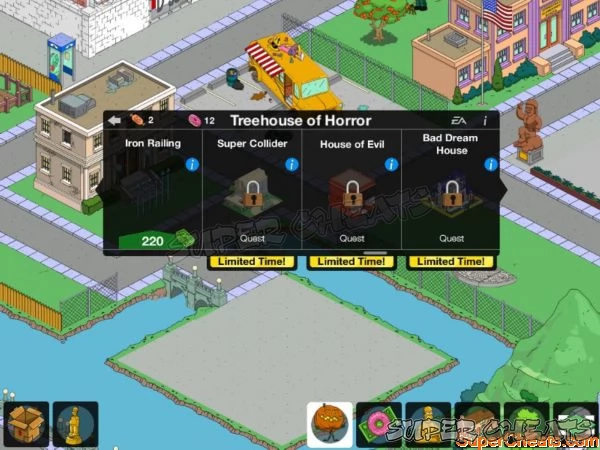
Throughout the year special holiday-themed events will take place
As the game begins Homer is seen holding his "myPad" (the Springfield Version of an iPad) upon which he is playing a Mobile Gaming App called "The Happy Little Elves" (a parody of the animated cartoon series The Smurfs) -- with the intensity of the turn-and-time-based game causing him to be somewhat hyper-focused upon the game to the exclusion of all else.
Appearing to be very frustrated by the game and its Game Play style -- which forces the player to wait after each action in the game before they can complete their next action -- basically they are talking about the same freemium system that the game uses -- Homer decides to skip some time.
Tapping into the RMP (Real Money Purchase) system in the game, Homer chooses to buy a significant quantity of Happy Little Elf Berries (the in-game item that can be universally applied to the different Game Play elements in order to speed up the game and its turn system), only to discover that the purchase actually costs him $1000 in real money!
The distraction of the game combined with his frustration and the realization that he has spent a large sum of Money, we hear him declare that he would blame the purchase on one of his kids in order to obtain a refund, as if THAT would work LOL.
With Homer's attention very effectively distracted, the alarms sounding and the catastrophe that is unfolding goes largely unnoticed by him until it is way too late.
The plant has a core meltdown, which then contributes to the conditions that are necessary to foment a catastrophic explosion at the plant that literally destroys the entire city of Springfield -- setting the stage for the story in the game.
If you are not a fan of the series it may help you to know that the Springfield Nuclear Power Plant, which is owned by the iconic series character Montgomery Burns, is notorious for being poorly maintained, poorly run and inadequately supervised.
A level of haphazard maintenance of such that it, combined with the unwillingness of its owner to spend the Money required to bring it up to code and make it safe, creates a long-running theme in the television show that is a mixture of an ironic juxtaposition and unlikely humor.
To put that in perspective for you, in the animated series there are elements that represent the safety flaws that routinely appear in both the opening sequence and the background during each show because like the plant security they are for the most part a running joke.
Examples include Homer accidentally taking fuel rods home with him in accidentally in his clothing, and when he discovers this that discovery triggers something of a running gag -- with different things happening to them as a result.
Another running gag is the past effects of the disastrous waste disposal policies at the plant, which are illustrated by irradiated glow-in-the-dark rats, skeletal remains of employees previously sickened and deceased through exposure to the toxic and radioactive waste are often seen stored in the basement of the plant, and throughout a number of episodes glow-in-the-dark people, three-eyed fish, and giant spiders can be seen.
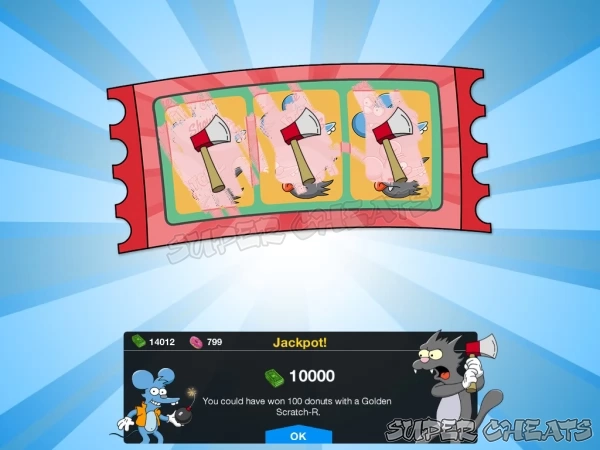
Playing the scratch ticket game at Kwik-E-Mart can pay-off big!
The odd leaking pipes in the bowels of the plant, improperly stored and leaking barrels of toxic and radioactive waste and a plethora of other serious safety violations contribute to an over-all highly negative impression of the plant that requires no verbal explaining or narration.
That probably serves as sufficient background to fill you in on the nasty safety violations that have been caused by Montgomery Burns' unwillingness to properly fund the safety and waste disposal side of his business -- but as you play the game keep an eye out for the barrels of waste that appear in odd places both in the plant and its urban and suburban environs -- that too is something of a running gag.
The presence of unusually high and very unsafe levels of radiation around the plant and its environs are witnessed in the form of very high readings on Geiger counters.
That radiation is caused by the partial melt-downs that have taken place on numerous occasions that were prevented from transitioning into complete melt-downs by Homer's unusually effective dumb luck in dealing with these emergencies in a case-by-case fashion as part of the sub-plot for each of the episodes in which the events took place.
As a side-note, the rather tongue-in-cheek rip on what has to number among the most popular mechanism used in freemium games today -- the time-delayed action system -- is just the sort of thing that the creators of The Simpsons are well-known for.
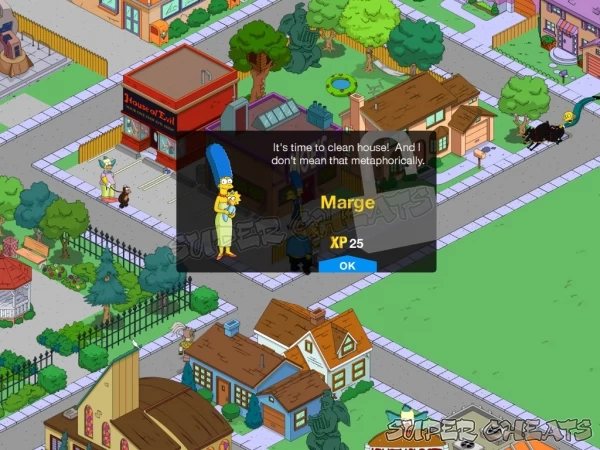
Each new character means more earning power and more tasks unlocked!
The Story Established
With the town now completely destroyed, the challenges and the basic theme has now been revealed to the player:
Homer (with the help of his family and friends) must rebuild Springfield from the ground up, and the Basic Game Play theme is now complete as this quest-based city-Building Game Play adventure unfolds.
In order to accomplish his goals of rebuilding Springfield the way that he (you, the player, actually) wants it to appear, it is necessary to complete a highly ordered and structured series of interlocking missions, quests, and their related tasks, as well as gap-quests that are used to stretch out Game Play in terms of time and effort, and to help the player to generate Income in order to pay for the construction costs.
This is primarily the set of activities that the player must embrace in order to obtain the Money that is required to progress the reconstruction of the town, though they are not compelled to build it in any specific or set pattern beyond that dictated by Level restrictions.
To make life more interesting and add to the challenge of Building and maintaining your city the developer added a multi-player aspect to the game permitting players to visit with each other, not merely adding a social interaction subsystem to the game, but potentially offering gamers the chance to explore a narrowly defined sense of Schadenfreude by going after key and valuable elements in their friend's town --sadly that ability to steal Items from your Neighbor's towns has since been removed from the game.
The Sincerest Form of Flattery
Players who have created their own city, having progressed to a reasonable level of development, and who have attached their game save to their external gaming and/or social media accounts, now have the option to add the cities of up to 100 friends to their game.
This allows you to visit your mates -- and for your mates to visit you -- to assess how well the reconstruction is going and to see what unique designs and layouts you have devised.
This also permits you (and your mates) to pick up some extra XP and Money along the way, as well as Donuts under specific circumstances!
Bear in mind that every player can add their friends via Facebook, Gmail, and their EA Origin Account, and leverage their device's Contact list to create their own Simpsons social network.
After the player has added their friends, they can then visit each personal versions of Springfield to complete up to three unique tasks each day (included among which is the ability to vandalize their friends city) -- and when special events are active there may also be special activities or collections that players can complete while visiting their Neighbors!
The maximum number of friends that you can add in your Tapped Out game is 100, and once you begin adding them and start visiting them your mates and their worlds become part of your game in an existential manner, making them -- and you -- a part of your personal and ongoing story!
Showing Off?
The process of reBuilding your Springfield taps into a creative spirit for most gamers, and in no time you find yourself employing a wide variety of techniques in the design process. Perhaps you are recreating street layouts from your real-world town? Maybe you are building Springfield the way that you think it should have been built all along?
Either way you will quickly discover that you are not alone in that creativity and, as you visit more and more of your Neighbor Springfield you are sure to find approaches that you never thought of yourself -- but clearly your mates won't mind when you "borrow" their ideas, right? Right!
The creativity and art flow that comes from Building and designing a city has really caught on with the community of gamers in Tapped Out -- in fact the art form is overflowing and honored! So honored in fact that the folks over at EA have even created a special section on the official chat boards where you can upload screen snaps of your town or what you consider to be its best features so that they can be judged by others!
Remember this is a game -- it is about having fun!
Anything missing from this guide?
ASK A QUESTION for The Simpsons: Tapped Out
Comments for The Story -- An Overview
Add a comment
Please log in above or sign up for free to post commentsTable of ContentsClose
- Introduction
- Important News - Please Read
- The Story -- An Overview
- Basic Game Play
- Player/Game Levels
- Cash and Donuts
- Community Friend Requests
- I Missed that Event / Item / Character....
- Character Finder Tool
- Neighbor Town Quick Nav Tool
- Improved Level Cap Income
- Who Is Sideshow Bob?
- Frink Points / Friendship Points System
- Contacting EA for HELP!
- Holidays & Special Events
- Walkthroughs
- Reference
- Trivia
- Addendum
Guide Updates
Get notified of updates to this guide
Many of our guides get updated with additional information. To get an email when this guide is updated click below.
 Join us on Discord
Click to close


Hello. It's some way how I can send my money and donuts to my friend' s account?
Lukewills218
Daily player.
Level 44.
Add me.
Add me pls docmed2000
I'm a daily player. Please add me, WildSugarPlum
Daily player. Add abc195704810
Looking to clear out deadbeat neighbors? I'm a daily player, and I don't do graffiti unless there's nothing else to tap on. Add me DerekF1990
Bubbleyfairy daily player
Please add me. I play pretty much all day. Origin ID - Benjamindelaney
test test
sbyrne135653
Add me
add me plz summasays
Add me! New player
Nodontsnepai
Add me please, daily player
abc26691998
Please Add me
iJuke.cwal
Mojodevil88 please add me
123muscles please add me
add me origin ID = Noeltorious
pls add me, daily player, peteronlym140
Caringone4186 add me!!!
Plz add me origin jbyrd1208
Please Add: CrazyDream101
elinerror add me i play daily
Playing daily, level 43. Add jade_wolf948
Please add me!! Play everyday and visit all the time
aeyes565808 please add me!
please add plstarlight
I play everyday and visit all my friends towns everyday
Plz add pumpkin448438
Add kenalbon89
Add me please jamestillm597
add me bmwogo i play daily